- 1520 GREEN ST, SAN FRANCISCO, CA 94123
- 415-567-WEST(9378)
- webmaster@dowoca.org
St Michael Orthodox Church in Concord, CA will be hosting two retreats during this lenten season!
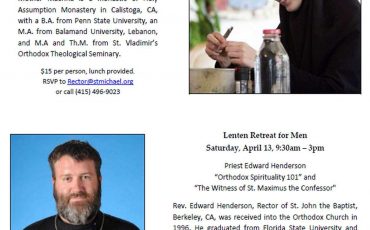
The first, on Saturday April 6th, will be for women only, with Mother Macrina Roeber as keynote speaker
The second, on Saturday April 13th, for men only, will be given by Rev Edward Henderson
GREAT LENT 2019
To the Reverend Clergy, Monastics and Faithful of the Diocese of the West
Dearly beloved,
Each year, we are given ample “warning” that Great Lent is approaching. The Church, for weeks, begins to move our minds to the effort to which we are called. And yet we constantly seem surprised that it is here! Great Lent is so easily understood as seven weeks of “following rules.” Which foods we can eat, how often to come to services, how often to come to confession, which books are better to read? The opposite temptation is to look at our Lenten effort as a bunch of “negatives.” Which foods are we not supposed to eat, what am I supposed to “give up” as my discipline?
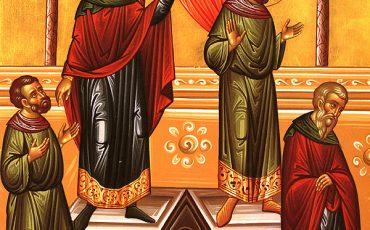
But the warning lights that have been flashing in the Church for more than a month now teach us something different. We begin with Zacchaeus, hear about the Publican and Pharisee and the Prodigal Son, are warned about the Great Judgment at the end of time, then are finally reminded by the Lord that if “you cannot forgive men their trespasses, neither will your heavenly Father forgive yours.” The common lesson is that our faith is the faith of the Other. Zacchaeus sought out the Other, the publican couldn’t even look up to the Other, the Prodigal returned to the Other, the redeemed at the end of time are redeemed because they cared for the Other, and finally we bow down before the Other seeking forgiveness.
The Other, of course, is the Lord Jesus Christ, and Great Lent is our journey towards His Passion, Death and Resurrection. But it is also obvious from the lessons the Church has given us that our faith is exercised by seeing the Other in each other. The rules of Great Lent mean nothing if they are not ultimately manifested in the way we treat each other as the Other. St. John Chrysostom asks “Why do you fast from fish and fowl when you devour each other?” Perhaps our greatest Lenten effort isn’t how much we fast, pray, come to church, confess our sins and give to the poor, but rather our greatest effort is to begin all those by seeking the Other, transfiguring our meager efforts into spiritual feats as great as the Saints because they are infused with the presence of Christ Himself and the power of the Holy Spirit.
I ask each of you, my spiritual children, to forgive me as we enter into the holy tithe of the year. I wish for all my faithful parishes and each and every one of you a most fruitful and joyous Fast. May we all rejoice in the celebration of the Lord’s Resurrection at the end of these most holy days.
With love in Christ,
†Benjamin
Archbishop of San Francisco
Many wonderful homilies have been delivered on Christ’s parable of the Publican and the Pharisee. Truly, this short teaching is a fruitful source of much wisdom. It is a study in contrasts: the Pharisee is outwardly righteous but inwardly unwell. The Publican, having no virtues to display, stands “afar off” and pleads for mercy. Our Savior declares the Publican justified rather than the other. There is something about what was going on inside the Publican that was right, and the parable invites us to explore and discover what it is.
This Sunday Gospel lesson is placed at the beginning of the Triodion period for a reason. Our Mother, the Church, desires that we, her children, receive great spiritual benefit from these upcoming days of Lent. We must be prepared and approach the forty days with the right inner disposition. I believe that the attitude we must assume is that of being a debtor.
Being a spiritual debtor begins with an awareness of our own sinfulness. It is a deep-seated realization of the enormity of sin that weighs upon us. It includes a vision of how that sinfulness has adversely affected our own lives and those around us. A debtor is unable to compare himself with others because he is so conscious of his extreme need for God’s mercy. Thus, he has no opportunity for fault-finding. A debtor relates to God with a correct disposition. He does not consider his salvation guaranteed. He is aware that without real repentance, he is in danger of being eternally lost. He is willing to do whatever it takes to allow God to heal him of his extreme spiritual sickness.
The hymnography of the feast directs us to follow the Pharisee in his virtues and to emulate the Publican in his humility. To those hearing the parable, Our Saviors uses emphatic words: “I tell you, this man went down to his house justified rather than the other.” The Publican’s attitude and disposition won the mercy of God. As he stood afar off, unable to lift his eyes to heaven, the Publican displayed a healthy shame for what he had done. Yet, he did not despair. He still regarded God as capable of hearing him. He had enough hope to at least ask for His mercy. In the brief description of the Publican, we are given a picture of what humility looks like. Thus, with a consciousness of our own sinfulness, an awareness that we are debtors, yet with a sure hope in God’s mercy, let us begin these blessed forty days of repentance.
Hieromonk Innocent
On December 19th (New Style), the Nativity of the Holy Virgin Parish celebrated Divine Liturgy for St Nicholas Day. This is, of course, always a much revered occasion for any Orthodox parish, but all the more so in our strong Slavic immigrant community. But this St Nicholas Day had an added jubilant atmosphere, as on that very day our longtime Sisterhood President, Tatiana Dimitrievna Diedovitch (known lovingly by all as ‘Tata’), turned 90 years young.
Tata, like so many ethnic Russians whose families fled the country after the Bolshevik revolution, came to America (by way of Brazil) from Harbin, China. She still taps into her Chinese background from time to time, speaking Mandarin with the Chinese inspector from the San Mateo County Environmental Health Services department who comes during our annual Christmas Bazaar to ensure health codes are being enforced (which of, course, they are, under Tata’s watchful eye).
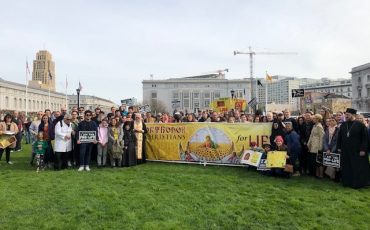
Another year of praying for an end to abortion and another peaceful, prayerful and successful West Coast Walk for Life! It was a joy to see so many Orthodox Christian clergy, monastics and faithful of so many jurisdictions. Special thanks to Father Serge Kotar for leading the service to end abortion; to Father Josiah Trenham, with the assistance of Emily Wilkinson, for organizing attendance by Southern Californians; and to Father Aris Metrakos of Holy Trinity Church and the wonderful staff at the Christopher Center for hosting them. We hope all are inspired and energized to incorporate sanctity of life prayer, service and education throughout the coming year.
You can download the PDF for the text of the service to end abortion here. You can also download the Encyclical of Metropolitan Evangelos, Greek Orthodox Metropolis of New Jersey, on the recent New York abortion law here. While this encyclical responds to a recent event, it is also a concise statement on the Church's teaching on abortion. Its issuance is timely and greatly appreciated.
Tempe, AZ
Come participate and learn from one of the greatest Orthodox Theologians of the 21st century, Fr. John Behr. He will be speaking about his upcoming new book: John the Theologian and his Paschal Gospel. A Prologue to Theology, on February 22nd at St John the Evangelist Mission in Tempe, AZ at 6 PM Arizona time.
This event will also simultaneously be live streamed to a global audience. Webinar Registration
Fr. John Behr’s new work brings three different kinds of readers of the Gospel of John together with the theological goal of understanding what is meant by Incarnation and how it relates to Pascha, the Passion of Christ, how this is conceived of as revelation, and how we speak of it. The first group of readers are the Christian writers from the early centuries, some of whom (such as Irenaeus of Lyons) stood in direct continuity, through Polycarp of Smyrna, with John himself. In exploring these writers, Fr. John Behr offers a glimpse of the figure of John and the celebration of Pascha, which held to have started with him.
The second group of readers are modern scriptural scholars, from whom we learn of the apocalyptic dimensions of John’s Gospel and the way in which it presents the life of Christ in terms of the Temple and its feasts. With Christ’s own body, finally erected on the Cross, being the true Temple in an offering of love rather than a sacrifice for sin. An offering in which Jesus becomes the flesh he offers for consumption, the bread which descends from heaven, so that ‘incarnation’ is not an event now in the past, but the embodiment of God in those who follow Christ in the present.
The third reader is Michel Henry, a French Phenomenologist, whose reading of John opens up further surprising dimensions of this Gospel, which yet align with those uncovered in the first parts of this work. This thought-provoking work brings these threads together to reflect on the nature and task of Christian theology.
Rocky Mountain Deanery Heads North for Meeting and to Honor Bozeman Church
It’s funny how business sometimes gets done in Orthodox churches, and the results are often unexpected. Like most deaneries, the clergy of the Rocky Mountain Deanery of the Diocese of the West like to support their sister church communities by attending one another’s Altar Feasts. Last November, these brother-priests found themselves talking business while enjoying a festive meal at St. Michael the Archangel Church in Pueblo, CO. The question at hand: where and when should they meet for their more official meeting in early 2019? “Let’s go up to Bozeman (Montana) for their St. Anthony parish feast day!”
St. Anthony the Great Church up the northern clime of Montana is a wonderful account of God blessing a small group of Orthodox Christians who persevere, often against the common wisdom of church planting experts and wisdom. Under the pastoral care of Fr. David Morrison, St. Anthony’s recently “graduated” from mission status to that of a parish. As such, this fledgling Orthodox church was transferred from the diocesan-wide Mission Deanery to the Rocky Mountain Deanery. One of the great challenges of Orthodox churches in areas like Montana is tremendous isolation. The closest Orthodox Church to Bozeman is a 2 hour drive. In fact, it has been an ordeal for the Montana clergy to participate in the Deanery’s meetings, requiring an expensive flight or arduous drive down to Colorado. The Colorado members of the Deanery decided it was time to change that pattern; it was their turn to make the effort.
2019 Pilgrimage Cruise to Alaska
With the blessing of His Eminence, Archbishop Benjamin of San Francisco and the West and the support of His Grace, Bishop David of Sitka and Alaska, a pilgrimage cruise and conference-at-sea will be held September 7-14, 2019.
A flyer and detailed information, including speakers and topics, costs, etc., are available online at https://www.culturallycreativetravel.com/pilgrimage-to-alaska-2020/
Sailing from Seattle to explore Juneau, Sitka, Glacier Bay, and other sites on the Holland America Eurodam, participants will attend a wide variety of daily lectures, liturgical services, visits and social gatherings. Bishop David will host the pilgrims in Sitka, and the lecturers will include Archpriest Michael Oleksa, a recognized authority on Alaskan history and spirituality, and Archpriest Laurent Cleenewerck, Rector of Saint Innocent Church, Eureka, CA, who will lecture on Orthodox apologetics.
Registrations should be made as soon as possible as the 50 slots are allocated on a first-come first-serve basis.
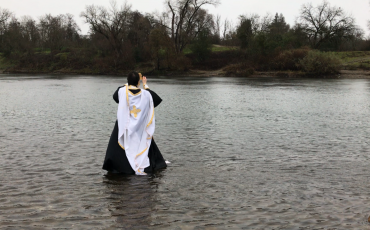
On Sunday, January 6th, the Theopany of Our Lord, God, and Savior Jesus Christ, as well as His baptism in the River Jordan by John the Forerunner, the Reverend Timothy Winegar and faithful of Elevation of the Holy Cross Parish in Sacramento gathered at the banks of the American River for the Great Blessing of Water. The American River is a 120 mile waterway that originates in the Sierra Nevada mountain range, and is known as the site where gold was discovered in 1848 that started the California Gold Rush. It flows into Folsom Lake just outside of Sacramento, and eventually confluences with the Sacramento River. By this confluence, the waters of the American flow into the San Francisco Bay Watershed. By flowing into the Bay, these waters then eventually join the Pacific Ocean and through the Pacific, reach the rest of the world. Thus, by blessing the river off of this rainy, rocky bank, the Orthodox faithful seen in these pictures invoke God's blessing on the living waters on the whole of His creation! "Great art Thou O Lord, and marvelous are Thy works, and there is no word sufficient to hymn Thy wonders!"
(photos courtesy of Melissa Dubovik)
Brothers and Sisters in Christ:
All of us here at Sts. Cyril & Methodius are deeply grateful for the amazing outpouring of love, prayers and generous financial support that we have received. We have been able to not only help our own parishioners, but also many others from our surrounding community impacted by the fire. We are still actively contributing to those in need with the funds we have left over. May God bless all of you for your love, prayers, kindness, and generosity in the face of this tragedy.
With much love in Christ,
Fr. Ian