- 1520 GREEN ST, SAN FRANCISCO, CA 94123
- 415-567-WEST(9378)
- webmaster@dowoca.org
by Father John Dresko
Annually, our country pauses to honor and remember, at least officially, workers in our country on Labor Day. It is important to reflect on the words of Saint Paul from his first letter to the Corinthians regarding a labor dispute in the early Church. In that reading (1 Cor. 9:2-12), Saint Paul talks about the rights of the apostles to make their living from the Church because they have worked so hard in the Church. Now I know that in the Orthodox Church none of our parishes have ever had a dispute about whether their pastor should be paid more or less (!), but nonetheless, it is a very important reading for us to dwell on. What's important is not just that Paul defends very vigorously the fact that the Church has a responsibility to care for its workers, but also that Paul points to the Church, to the Corinthians, as the sign that he has worked in the Church. He says to them, "Am I not an apostle?...You (meaning the Corinthians, the faithful of the Church) are the seal of my apostleship." (1 Cor. 9:1-2) He is saying, "You are the example that what I have done is work very hard in the vineyard of the Lord and that work has brought forth fruit, because you, the people of Corinth, are the seal of what I have done." They prove the apostleship of Paul; they justify his labors.
In America, we have a funny idea of labor. Generally speaking, we have laws that prohibit people from working until they're about 16 years old. We also have laws that say when you reach a certain age (about 65 or 70), you have to stop working. You have to retire. We have really three areas of labor that we have defined for American society: labor, retirement and, perhaps most important, inheritance. The American ideal is to reach working age, start out in your life's career, make your money, put away enough for retirement, and then, by not squandering it, leave an inheritance to those loved ones whom you choose. The problem in America is that we tend to take the same ideas and ideals about labor, retirement and inheritance and apply them to our Church life and our individual spiritual lives. We look at labor and say, "You aren't supposed to work until sixteen." But in the life of the Church, if we waited until everyone is sixteen and then expect them to take up some of the burden of the life of the Church, we will shoot ourselves in the foot. They will not be involved enough in the life of the Church to want to stay until they're sixteen.
The most recent issue of Orthodox Arts Journal (August 1) is headlined by a interview of Iconographer Matushka Ann Margitich of St. Seraphim Cathedral in Santa Rosa, California. The article, entitled A Surpassing Gentleness: An Interview with Iconographer Ann Margitich, by Andrew Gould, can be access by clicking
A video highlighting the work going on in the Diocese of the West, prepared for and debuted at the 19th All-American Council held July 23-27 in St. Louis is now available online. If you wish to view the video, click
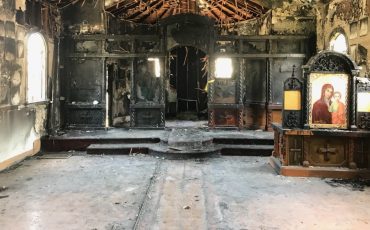
According to multiple media reports, the West Sacramento Fire Department quickly responded to an 8:00 a.m. call alerting them of a fire that engulfed the interior of Holy Myrrhbearing Women Churchon Thursday, July 12, 2018.
While the blaze was quickly entinguished, the church suffered significant damage, not only to its interior—the iconostasis and altar area were especially hard hit—but also to its bell tower. No one was in the church at the time, and an investigation to determine the cause of the fire is underway.
According to KCRA-TV 3, an unidentified person called 911 to report flames coming from three church windows. Fire Department representative John Heilman told KCRA reporters that crews arrived to find the church fully engulfed in flames.
“Investigators believe the fire originated somewhere in the altar,” long-time parishioner Constantine Baranoff told reporters. “So that’s where most of the damage appears to be.”
In what Baranoff called “a miracle,” three large icons—the Kazan Icon of the Mother of God, Saint Nicholas and Saint John of San Francisco—were barely touched by the fire.
“We’ll start cleaning up and decide how we’re going to rebuild this church,” Baranoff said.
Upon learning of the tragedy, His Eminence, Archbisihop Benjamin of San Francisco and the West contacted Archpriest Matthew Ismailov, Rector, and pledged to visit the parish on Monday, July 16.
Donations for reconstruction efforts may be sent to the Holy Myrrhbearing Women Church, 833 Water Street, West Sacramento, CA 95605. A GoFundMe relief fund also has been set up to help the church.
His Eminence, Archbishop Benjamin, led the clergy and faithful of the Diocese of the West in the annual (since 1925) pilgrimage to Fort Ross on the 4th of July. This year's weather was overcast and cooler than usual -- a very comfortable day. Fort Ross is now a state historic park and is the site of the first Orthodox house of prayer south of Alaska.
His Grace, Bishop Gideon of Makarov, Vicar of the Kyiv Metropolis, prayed at the Divine Liturgy and received the Holy Gifts.
(Photographs courtesy of Matushka Sophia Sokolov)
Link to full gallery: https://holy-trinity.org/community/2018-0704-fortross
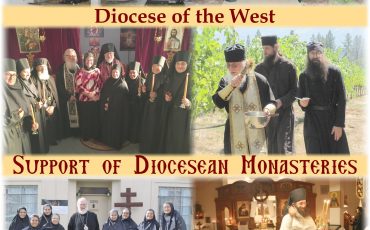
At the request of His Eminence, Archbishop Benjamin, all parishes in the Diocese of the West will be taking a special collection this Sunday to benefit the various monastic communities of our diocese:
St. John of Shanghai and San Francisco
Manton, California
http://www.monasteryofstjohn.org/
St. Barbara Monastery
Santa Paula, California
Holy Assumption Monastery
Calistoga, California
Our Lady of Kazan Skete
Santa Rosa, California
Protection of the Holy Virgin Monastery
Lake George, Colorado
Monastery of St. Macarius of Egypt (2015)
Monastery of St. John the Baptist (2017)
The following reflection on monasticism was published on pemptousia.com and is recommended reading to prepare for our efforts to assist the monastic communities of our diocese.
MONASTICISM: The Way to Perfection
by Professor Emeritus George Mantzaridis
Theological School, Aristotle University of Thessaloniki
With the advent of monasticism, a special way of life appeared in the Church, which however did not proclaim a new morality. The Church does not have one set of moral rules for the laity and another for monks, nor does it divide the faithful into classes according to their obligations towards God. The Christian life is the same for everyone. All Christians have in common that “their being and name is from Christ”1. This means that the true Christian must ground his life and conduct in Christ, something which is hard to do in the world.
What is difficult in the world is attempted with dedication in the monastic life. In his spiritual life the monk simply tries to do what every Christian should try to do: to live according to God’s commandments. The fundamental principles of monasticism are no different from those of the lives of all the faithful. This is especially apparent in the history of the early Church, before monasticism appeared.
Hieromonk Innocent
St. John's Monastery
Spring has been unusually long and cool this year. Looking out the window as I write this, I see green grass and flowers everywhere. The wet, temperate weather has brought us a season to be remembered. Two weeks ago, on the feast of the Ascension, I wandered through the monastery forest, taking pictures of the wildflowers. Everything is beautiful, and I feel sometimes feel unworthy of this wonderful place we call earth.
Not many weeks from now, the grasses will produce their seed and die. The flowers will soon fade and disappear. All the vegetative under-story will take on a straw-yellow color, characteristic of a California summer. The conclusion seems unavoidable: life follows death, the sunrise of Spring is replaced by twilight and the darkness of night.
As I watch my loved ones age and approach death, I am reminded that I, too, am mortal. I can't help asking, "Why?". Why does Spring end? Why is flower of youth so quickly followed by decline, sickness, and death? Why must my life end when it seems to have only just begun? Are we to believe, as the famous Greek philosopher Plato taught, that life in this world is transient? Are we really just part of an eternal cyclical process? Are we forever confined to this world of change? In a word, no.
The Preacher wrote: "He has made everything beautiful in its time; also he has put eternity into man’s mind, yet so that he cannot find out what God has done from the beginning to the end" (Eccl. 3:11). To me, these words mean that we are supposed to see that we were meant for eternity. We were supposed to sense the dissonance of our transient life and the yearning silent conviction of life without end. Death is not natural. Body and soul, we are destined to live forever. The seasons of Pascha and Pentecost are strong reminders that God's ultimate purpose is the restoration of Paradise. This restoration must begin in our repentance. Perhaps that is why we live here and now in a world of transience, where, by God's grace there is a possibility for change.
On Saturday, May 26, our cathedral community was joined by clergy and faithful from around the Bay Area to celebrate the glorious vigil of Pentecost with His Eminence, Archbishop Benjamin. Following the vigil, we enjoyed a repast together and heard from Fr. Joseph Kwame Ayete Labi about the Church in Ghana and were offered an opportunity to help with theological education there. We were also joined by master Iconographer Dmitry Shkolnik who shared his vision for beautifying the dome of our temple.
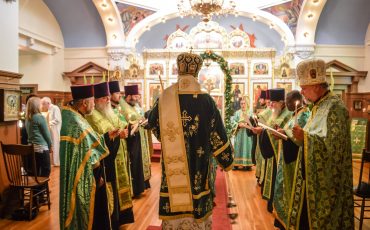
On Sunday, May 27, the great and last day of Pentecost, the feast of the Trinity, we celebrated our patronal feast day. His Eminence, Archbishop Benjamin, was assisted by Mitred Archpriest Ian MacKinnon, former Chancellor of our Diocese; Protopresbyter Joseph Kwame Ayete Labi; Archpriest Kirill Sokolov, Cathedral Dean; and Priest Peter Fermeglia. At the Little Entrance, His Eminence bestowed the dignity of wearing the kamilavka upon Protodeacon Brendan Doss. This high honor had been awarded by the Holy Synod of Bishops at its spring session. At the Kneeling Vespers and Molieben, we were joined by Mitred Archpriest Peter Perekrestov of Holy Virgin Cathedral (ROCOR) in San Francisco.
A wonderful festive meal continued the joy and fellowship that had been made manifest in the receiving of the Holy Eucharist that morning. At the meal, the cathedral parish recognized His Eminence, Archbishop Benjamin’s paternal love for us and presence with us as well as his upcoming birthday on June 1.
The cathedral is marking its 150th anniversary this year. In 1868, the first permanent Orthodox priest was assigned to the mission in San Francisco. This marks the anniversary of established Church presence in the Bay Area, California, and the contiguous United States. We will mark this anniversary with praise and thanksgiving in celebrations to be led by His Beatitude, Metropolitan Tikhon, on Saturday, October 20. For more information, please contact Fr. Kirill Sokolov, cathedral dean, at frkirill@holy-trinity.org.
Photos: https://holy-trinity.org/community/pentecost-2018.html
Archpriest Vadim Pogrebniak, 80, Pastor Emeritus of Saint Spiridon Cathedral, Seattle, WA and former Chancellor of the Orthodox Church in America’s Diocese of the West, fell asleep in the Lord on the afternoon of the Leavetaking of Pascha—Wednesday, May 16, 2018. In 1980, Father Vadim assumed the pastorate of Saint Spiridon’s, from which he retired on December 31, 2007. Earlier, he served parishes in New Jersey, Pennsylvania, and New York, as well as Dean of Holy Trinity Cathedral in San Francisco. In addition to his pastoral ministry, he was widely known for his expertise in the field of liturgical music and choral conducting.
The Funeral Service for a Priest will be celebrated at Three Hierarchs Romanian Orthodox Church, 6402 226th Street SW, Mountlake Terrace, WA on Monday, May 21 at 6:00 p.m. The Divine Liturgy will be celebrated on Tuesday, May 22 at 9:00 a.m., followed by interment at Edmonds Memorial Cemetery, Edmonds, WA. A repast will follow at the church. Father Vadim is survived by his beloved wife, Matushka Helen, and their sons Kyrie and Deema.
Additional information and the schedule of services will be posted as they become available.
May Father Vadim’s memory be eternal!
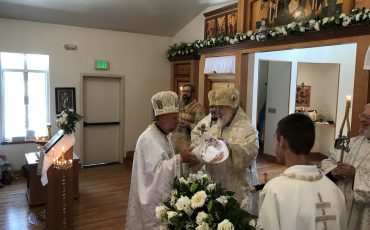
Our beloved former chancellor, Archpriest Ian MacKinnon, was awarded the dignity of wearing a priestly mitre and presented with a Synodal Gramota marking his 40th Anniversary of Priesthood and retirement at a hierarchical Divine Liturgy on Sunday, May 13, 2018. Seven priests and four deacons joined His Eminence, Archbishop Benjamin and His Grace, Bishop Daniel in the celebration of the Liturgy at Elevation of the Holy Cross Orthodox Church, Sacramento, California.
His Eminence remarked on Fr. Ian's years of faithful service as chancellor, first to Bishop Tikhon and then to Archbishop Benjamin, and his pastoral care for the faithful of Holy Cross. The archbishop noted the many sacrifices Matushka Nina and their family have made and the support they have given him through out his priesthood.
Link to some of the festivity pictures here.