- 1520 GREEN ST, SAN FRANCISCO, CA 94123
- 415-567-WEST(9378)
- webmaster@dowoca.org
by Priest Andrew Smith
Each year, rain or shine, April or May, Old Calendar or New, the exciting and world changing cry of the Paschal Greeting, “Christ is risen!” ushers joy into all of our lives at the end of our candle-lit processions. As we pour into the church singing the Paschal Troparion, truly, all is filled with light. The next day, at Agape Vespers, though there are often fewer worshippers, God’s saving plan has lost none of its luster as we hear the Gospel proclaimed in many languages.
Then vigil and liturgy for Thomas Sunday come and in many parishes we notice how so few of those who answered “Indeed He is risen!” at the paschal vigil have come to bear witness to Antipascha. This can quickly become a downward spiral that reduces that exuberant shout of joy on the first Sunday (and first day of the new creation) to a tired, hoarse wheeze by the fourth or fifth Sundays of the Pentecostarion, the ‘flowery’ Triodion containing the hymns of the Paschal season.
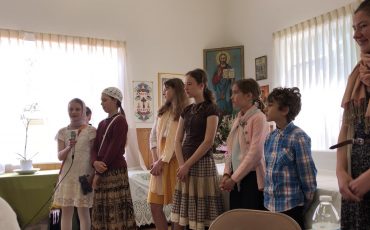
Anna Rikhter, parishioner of The Nativity of the Holy Virgin Orthodox Church in Menlo Park, CA, had other ideas. With the blessing of Fr Andrew Smith, she distributed a list of poems by Russian writers about the feast of Pascha (https://foma.ru/stixotvoreniya-o-pasxe.html) to church school students. Each student wishing to participate chose a poem, committed it to memory, and practiced it after church school on Sundays during Great Lent.
Monk Cosmas
St. John of Shanghai Monastery
Can the demons read our minds? Do they know what we are thinking? Do they know what we are feeling?
Okay, those are trick questions. The Fathers say that the demons do not read our minds and cannot peer into our hearts. What they do, instead, is to throw all sorts of provocations and temptations our way and watch for our reactions. Sort of trial and error, you might say. Then when they see us react to some particular kind of temptation, they toss more of it in our direction. If we react to the temptation of food, they send us more thoughts about delicious meals and snacks. If we respond to images of wealth, we get more images of money and luxury. If we show a weakness about sex, we receive more provocations of the same sort.
That means that our part in spiritual warfare consists primarily in not reacting, so that we don’t give them information that they can use against us.
Now let’s take a look at something completely different, “sponsored content” on social media on the internet.
What happens when you click “like” or “dislike” on a company’s ad or on a paid post about some political or social issue? Hmm… suddenly you start getting more of the same from that company or organization, and you also begin to see similar things from other companies or organizations. What is working behind the scenes is what computer people call an algorithm.
These algorithms seem to keep track of everything we do online and pass information from one program to another. I have even had the experience of looking up a book on the web site of the local public library, only to have amazon try to sell me the same book less than a minute later.
Can these algorithms read our minds? Do they know what we are thinking? Do they know what we are feeling?
You might laugh at this point. Algorithms act pretty much like artificial intelligence demons, don’t they? Let’s not indulge in paranoia and suppose that software engineers deliberately made them resemble demons, but we Orthodox Christians are fortunate. We can treat these provocations in the same way as we treat any other provocations. We can use the same wisdom and self-control when we are online as in other parts of our lives, and not give away information to algorithms that we would deny to demons.
by Father Innocent, Abbot, St. John's Monastery
Orthodox LIFE School 2018
“If you fail to plan, you plan to fail.” This oft repeated adage carries a practical truth that can rightly be called common sense. Yet how often do we, as a Church, fall short in heeding this practical advice? We fall short, most particularly, in how we teach, equip, and prepare our young people to assimilate the life of the Church and stand firm in the Faith as they enter an independent life in the world.
In his address at our last Diocesan Assembly last year, His Eminence, Archbishop Benjamin, warned us of the increasing loss of young adults from our parishes. He described the now familiar pattern of seeing a child grow up in the parish, come to services, graduate from high school, and leave home for college never to return to any Orthodox parish thereafter. This sad trend leaves our parishes bereft of the strength and vitality of our young. More pressingly, it drastically reduces the number of young people who choose a priestly vocation and go on to seminary. We face a dilemma: many older parish priests seek retirement only to discover there are no younger priests to replace them. We can blame ourselves for delivering a shallow spiritual life to our young people with the resulting scarcity of vocations and continuity in Church life, altogether. Clearly, Sunday morning spiritual life alone is insufficient to strengthen and fortify a young person launching out on his own. It is imperative that we give the fullness of the faith to our young so that they can live in it and thrive on their own. Without this foundation, we are “planning to fail.” More than ever before, the world has become a spiritual meat grinder that destroys young souls. Yet, there is hope.
During Great Lent this year, the Southern Colorado Greek and OCA parishes joined together on the theme of outreach and evangelism during the Sunday night Vespers in Colorado Springs, Pueblo and Calhan.
A simple summary of the overall message :
The first step in evangelization is dedication of one’s own life to God, not simply at conversion and baptism, but throughout our lifetime as new experiences change and deepen us. Do we sometimes feel we have two lives, a secular worldly life and a Church life? This indicates a need to re-dedicate our whole life to Christ. Do we have inner imaginary thoughts and temptations that we keep secret, an inner life separate by our own design from God? These deep and hidden inner places need to be opened, these inner places dedicated to God, which is a theme of Great Lent. All the homilists gave examples of transformational witness in their own lives and in the lives of the saints.
“Do you not know that all of us who have been baptized into Christ Jesus were baptized into His death? We were buried therefore with Him by baptism into death, so that as Christ was raised from the dead by the glory of the Father, we too might walk in newness of life. For if we have been united with Him in a death like His, we shall certainly be united with Him in a resurrection like His….” (Romans 6:3-5, Baptismal Epistle)
HOLY WEEK AND PASCHA 2018
To the Reverend Clergy and Faithful of the Diocese of the West
Dearly beloved:
Christ is Risen! Indeed He is Risen!
In an “early” Paschal celebration, such as we experience this year, it is easy to be caught off-guard in our preparation for the celebration. Confessions are put off because it doesn’t “feel like time yet,” fasting started very early (indeed, only a few short weeks after the Nativity Fast) and has grown wearisome., and our prayer faces the same temptation it always faces — to be lost in the cares and hustle and bustle of daily life. The Lenten “imps” have been nipping at our heels for weeks now.
Therefore, it is more important than ever that we make a concentrated effort to travel with the Lord on His journey through the resurrection of Lazarus in Bethany, His triumphant entrance into Jerusalem, the daily back and forth between Jerusalem and Bethany, preparing all of His disciples (including each of us) for the coming Passion, teaching us about His Kingdom through parables, and finally standing at the Cross and the empty tomb as we share in the wondrous miracle of His Resurrection. The Church’s calendar delicately unwraps the layers of the Messiah’s coming to His Passion. All we need to do is come and see, open our hearts, and ask Him to illumine each of us with the Resurrected Light.
by Archpriest Lawrence Russell
Most of us remember the first time we heard or read the word “oxymoron,” a funny-sounding, funny-looking word; right? Oxymoron is a combination of two Greek words: oxys (sharp) and moros (stupid). Together, they mean “pointedly stupid.” As a figure of speech, an oxymoron describes an idea built of opposites, antonyms. Try “living death,” or “cruel kindness,” for instance. What strikes us in such pairings is contradiction, in and of itself. Finding oxymorons can be mere amusement, but discovering “needed oxymorons” can be riches indeed for our journey to the Kingdom.
Oxymorons generally are not used by scientists or engineers, but by writers – who choose them as a literary device – and especially (for our purposes) by Christian Theologians, who need them because the paltry categories of this limited world are not broad enough to express Divine Truth. They provide the “new wineskins” needed for the “new wine” – “else the wine will burst the skins, and the wine perisheth, and the skins” (Mk. 2:22).
In the spiritual realm, we find great depths in each oxymoron when we choose to look. After all, this is the realm in which God truly has brought together Life and death: Christ is, as the eternal Son of God, deathless Life; and He dies, as the God-man, a Life-filled death. When our Immortal, Life-giving Lord enters our world—a world subject to death—He bridges the chasm that separates Life from death! We see this in His Incarnation, in His Passion, in His Resurrection. This is what the Apostle Paul dared to call the “foolishness of God,” which is wiser than the “wisdom of men” (1 Cor. 1:25). Did you catch it: wise foolishness?
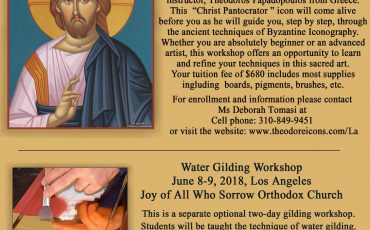
In June 2018, the master iconographer and world renowned icon painting instructor Theodore Papadopoulos will be coming to Los Angeles to provide his 6-day icon painting workshop and 2-day gilding workshop. This is his only stop in Southern California, and we are honored to have him come to our "Joy of All Who Sorrow" OCA mission in Culver City to teach. Mr. Papadopoulos will be providing most supplies, including boards, pigments, brushes, etc. The daily sessions will run from 9:00 am to 4:30 pm (or up to 6:00 pm, as needed). The best accommodations are through Airbnb, which are readily available in Culver City, including houses or apartments/condos to share, if desired. One of our participants has already found a walking-distance Airbnb for $60 per night.
There is limited space in both workshops in Los Angeles, so if anyone is interested, I can be reached at deborahtomasi@yahoo.com or via cell at 310-849-9451. Interested individuals can either email (with "Los Angeles Icon Workshop" in the subject line), call, or text. Time is of the essence, as all of our spaces may be filled soon.
For both workshops, June 8-9 and June 11-16, the total cost is $900, including a $350 non-refundable deposit.
The icon painting workshop alone is $680, including a $250 non-refundable deposit.
The gilding workshop alone is $270, with a $150 deposit. However, the price listed above for both workshops includes a $50 discount off the gilding portion.
This year, Mr. Papadopoulos will be conducting his icon workshops in London, Ireland, Germany, and the United States.
One can see Mr. Papadopoulos website by visiting:
-Matushka Deborah Tomasi
Hieromonk Innocent
St. John's Monastery, Manton, CA
Eighteen years ago, I converted to the Orthodox faith. During my years as an inquirer, I tried to follow the ascetic practices if the Church, including keeping the fast of Great Lent. For the particular parish that I attended, fasting meant the type of food (essentially vegan) and the quantity. Eager to follow all the customs, I requested that my apartment be blessed. The priest set up an appointment for the afternoon during one of the days of the Fast.
"How are you?"
"I'm hungry."
"I am glad." A smile teased his lips. "That is music to my ears!"
For a moment, his reply struck me as sadistic--for him to be glad at my misery while I tried to follow all the rules! Then I realized that his smug satisfaction was actually proof of his pastoral success. As he had taught us, Lent was supposed to be uncomfortable, it is supposed to cause real hunger pangs. His future catechumen was starting to get it.
Real hunger, in fact, is extremely beneficial. At my monastery, as in many parishes and monasteries in the Orthodox world, the first three days of Lent are spent attending many services in the chapel and eating nothing at all. It is amazing how at peace the body becomes when it is free of the burden of digestion. Thinking becomes easier. The perennial mental fogs lifts. The pounding onslaught of thoughts slows down. During the long services, the words of the Psalms, in particular, seem to sink in as never before.
After years of suffering from chronic pain and other enigmatic symptoms, Matushka Priscilla Shipley was recently diagnosed with Multiple Sclerosis (MS). According to the MS Society, symptoms of MS are often mistaken for other conditions including Lyme Disease for which she tested positive for several years ago. Mat. Priscilla has tried every treatment under the sun to address what doctors thought were Lyme symptoms, all the while leaving her MS untreated for years. Unfortunately, the MS progressed rapidly and just recently Mat. Priscilla was rendered blind in one eye and unable to walk. Last week they went to Stanford, and had a very long informative appointment. It turns out that not only does Mat. Priscilla have MS, she also has a rarer disease called Neuromyelitis Optica or NMO. It's similar to MS, but much more serious and can be fatal. She will have to do more tests to rule out cancer, and then if there is no evidence of cancer start treatment for the NMO as soon as possible. This means immune suppressing infusions and steroids, among other things.
Her husband, Fr. Ian (the full time priest at Sts. Cyril and Methodius in Chico, CA) has been caring for her at home. Doctors are unable to tell whether these debilitating conditions will be permanent or not. Until then, the family is in great need of outside assistance while they travel to Stanford and UC Davis so that Matushka can begin her tests and treatments. We ask for everyone’s prayers, and we also ask that you please consider helping to contribute financially, not only so that they might be able to work with home health aides who can provide much needed support, but also to help fund necessary renovations to their bathroom (to accommodate a wheelchair), travel expenses to and from Stanford and probably UC Davis and any additional medical costs not covered by insurance. Thank you.
To support the Shipleys, please click on the link: https://www.youcaring. com/priscillashipley-1089613
GREAT LENT 2018
To the Reverend Clergy, Monastics and Faithful of the Diocese of the West
For if you forgive men their trespasses, your heavenly Father will also forgive you. But if you do not forgive men their trespasses, neither will your Father forgive your trespasses. Moreover, when you fast, do not be like the hypocrites, with a sad countenance. For they disfigure their faces that they may appear to men to be fasting. Assuredly, I say to you, they have their reward. But you, when you fast, anoint your head and wash your face, so that you do not appear to men to be fasting, but to your Father who is in the secret place; and your Father who sees in secret will reward you openly. Do not lay up for yourselves treasures on earth, where moth and rust destroy and where thieves break in and steal; but lay up for yourselves treasures in heaven, where neither moth nor rust destroys and where thieves do not break in and steal. For where your treasure is, there your heart will be also. (Matthew 6:14-21, Gospel reading for Forgiveness Sunday Liturgy)
Dearly beloved,
Mere moments before we enter the Great Fast, the Church in her wisdom calls us to reflect on the essential elements of a truly Lenten effort. Prayer is a part of every Orthodox Christian’s life — it almost goes without saying. That prayer becomes the foundation of everything else we do during Great Lent. Besides our personal prayer, the Church calls us to more corporate worship, giving us the Eucharist as many as four times a week to strengthen us in our efforts.
But the Lord brings our attention to the other great tools of true spiritual effort. First, fasting. The true fast does not find fruits in following mere “rules.” “What can I eat? Does this have any milk in the ingredients? When can we have fish, wine or oil?” Those rules are there as guidance and not as ends in themselves. We can feel so proud that we have “followed the rules.” But the self-denial of fasting also leads to peace, calm, a new look at the things we too often see as important. In our consumer society, we never deny ourselves anything at any time. We have truly come to believe that man does “live by bread alone.” The lengthy, and sometimes grueling, fast strips us of the superfluous and leaves only the essential. We learn to eat to live, and not live to eat.